Snorkeling with sharks and stingrays in Moorea: where, how and which tour
Where to snorkel with blacktip reef sharks and stingrays in Moorea, how safe it is, the feeding ban, what a tour costs and how to choose between shared and private boats.
You can snorkel with wild blacktip reef sharks and pink whiprays in Moorea without any diving certificate: the main site is a shallow sandbank in the northwest lagoon off Tiahura and Les Tipaniers, where adults can often stand in waist- to chest-deep water. Go by boat, because the site is too far out to swim to from the beach, and keep your hands to yourself: feeding sharks, rays and other fish is banned in Moorea. The Moorea Lagoon and Reef Snorkeling Tour with Drinks (from $114 per person, 4.9 from 190+ reviews) covers the sandbank, reef sharks outside the reef and turtles in four hours from Tiahura.
Check Availability
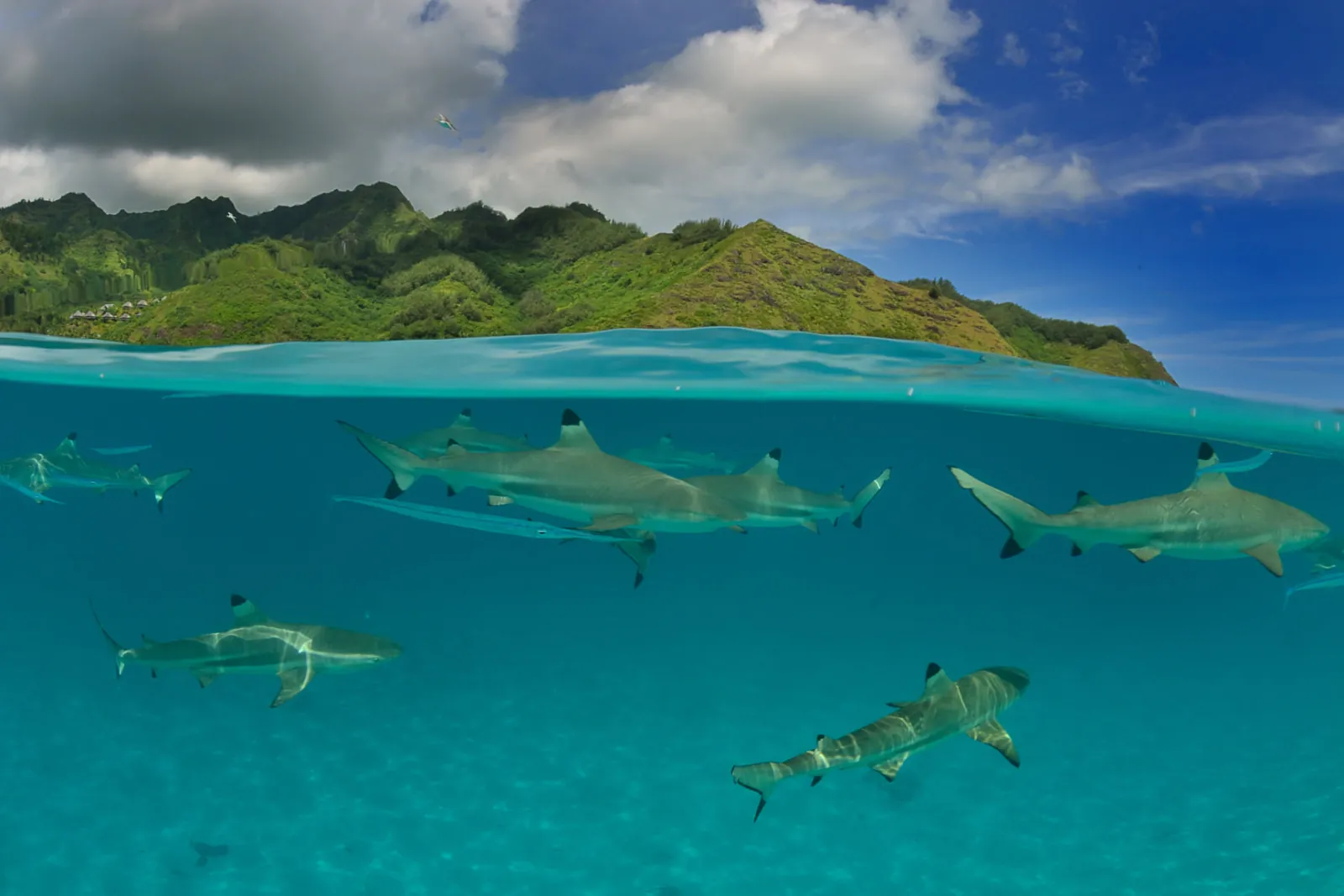
The water is clear enough that you see shadows on the sand before you see the animals. A stingray glides past a few meters away while a blacktip reef shark cruises through the shallows, its black fin tips sharp against the sand.
Most tours pair the sandbank with coral gardens and reef fish, and some add turtles or other rays. The photos make it look simpler than it is. The animals are wild, some sites have boat traffic or currents, and operators must follow Moorea’s marine rules. Below are the sites, the safety points, the rules and the tours to compare. For a wider comparison of every snorkeling trip we sell, see Moorea snorkeling tours; for sites you can reach on your own, see the best snorkeling in Moorea.
Moorea shark and stingray snorkeling at a glance
| Question | Quick answer |
|---|---|
| Can you snorkel with sharks in Moorea? | Yes. Guided snorkels with blacktip reef sharks are a popular lagoon trip |
| Where is the main shark-and-ray spot? | The shallow lagoon off Tiahura, opposite Les Tipaniers |
| What sharks will you see? | Mainly blacktip reef sharks on shallow lagoon trips |
| What stingrays are common? | Pink whiprays, also called Tahitian stingrays |
| How deep is the water? | Often waist- to chest-deep at the sandbank, but it varies |
| Do you need scuba gear? | No. A mask, snorkel and sometimes a flotation aid are enough |
| Is it suitable for children? | Often, with a good guide, close supervision and calm conditions |
| Typical tour length | About 3–4 hours for a half day, longer for full-day trips |
| Typical shared-tour price | About 11,000–16,000 XPF per adult from local operators; from $114 online |
| Best time of year | All year, depending on the weather and each operator’s season |
| Can you touch or feed the animals? | No. Feeding sharks, rays and other fish is banned in Moorea |
The Tiahura sandbank is offshore, not a beach-entry spot. Tahiti Tourisme recommends getting there by kayak or on an organized boat trip rather than trying the long swim from shore.
Other Experiences
Other experiences you might enjoy
More Moorea whale and lagoon tours, each with its own page and booking link.
1. Where can you swim with sharks and stingrays in Moorea?
The best-known shark-and-ray site is in the lagoon off Moorea’s northwest coast, near Tiahura and Les Tipaniers. People call it the shark and ray sandbank, the Tiahura sandbar or just the stingray spot. It is a shallow, sandy patch of turquoise water with Moorea’s green mountains behind it.
Tiahura shark-and-ray sandbank
Best for: first-time visitors, families, underwater photographers and anyone who wants a close look without scuba diving.
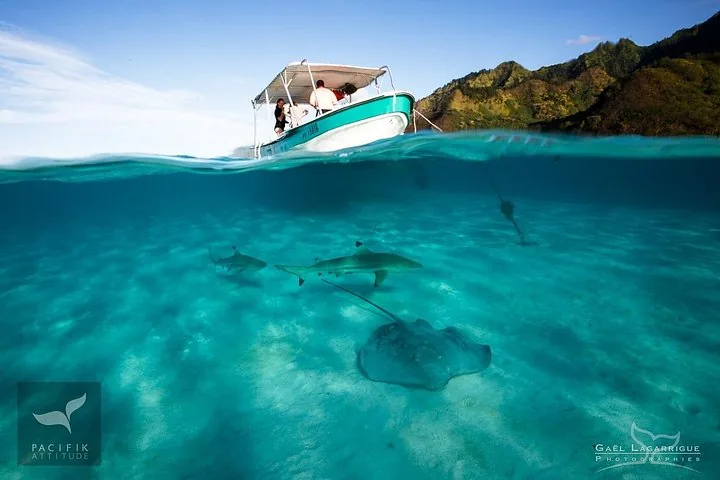
Unlike a reef wall, the sandbank is shallow. In places adults can stand on the sand while stingrays swim around them and reef sharks pass through the water nearby. The rays may come close out of curiosity, or because they have learned to associate people with food in the past. The blacktip reef sharks usually keep moving and keep some distance. The pale sand makes the animals easier to see than over coral.
It is a busy stop. Several boats can be there at once, especially in holiday periods. Choose a small-group trip, or ask the operator whether it can time the visit to avoid the biggest crowds; no guide can promise you an empty sandbank.
Coral gardens near Tiahura
Best for: reef fish, coral and more varied snorkeling.
Don’t skip the coral. The water around Tiahura’s offshore motu has coral and colorful reef fish: depending on the spot you may see butterflyfish, parrotfish, surgeonfish and other reef species. Unlike the sandbank, a coral garden means swimming or floating over the reef the whole time. Don’t stand, kick or rest on coral, even where it looks shallow.
For a first visit, a tour that combines the sandbank with a coral garden gives you the best of both: big animals first, then classic reef snorkeling.
Lagoon channels and turtle-viewing sites
Some longer trips visit channels or deeper parts of the lagoon where green turtles and other rays may turn up. These sites are not for beginners, because the current can be stronger. Some tours offer drift snorkeling, where you float with the current while the guides watch. Confident snorkelers love it; check the swimming level the operator expects.
Don’t assume every Moorea snorkeling stop is like the sandbank. One stop means standing in calm water, another means swimming over a deep coral channel.
2. What sharks and rays will you see?
Moorea has a varied cast of sharks and rays, but a standard lagoon trip does not show you all of them equally.
| Species | Scientific name | Where and how likely |
|---|---|---|
| Blacktip reef shark | Carcharhinus melanopterus | The main shark on lagoon trips; patrols shallow water |
| Pink whipray (Tahitian stingray) | Pateobatis fai | The large rays at the sandbank |
| Spotted eagle ray | Aetobatus ocellatus | Possible on deeper lagoon or channel snorkels |
| Sicklefin lemon shark | Negaprion acutidens | Outer reef, mostly on dives, not at the sandbank |
Blacktip reef shark
The shark most visitors come for. You know it by the black tips on its fins, and it often patrols shallow tropical lagoons. Most blacktips pay more attention to their surroundings than to people, but they are wild predators: never approach or feed one.
Pink whipray (Tahitian stingray)
These big, graceful rays are often the animals that seem most interested in you at the sandbank. Their wide bodies and long tails make great photos. They have venomous tail spines, so never grab, step on or crowd them.
Spotted eagle ray
Locally sometimes called a leopard ray, it has pale spots across a dark back. Eagle rays usually swim in open water rather than resting on the sand, and you may see them on deeper lagoon or channel snorkels.
Sicklefin lemon shark
A much bigger shark found around Moorea’s outer reefs. Lemon sharks are a scuba-diving sighting more than a Tiahura sandbank one, so don’t expect them on a family snorkeling trip.
Are these sharks dangerous?
Blacktip reef sharks are a low risk to people when left alone, but low risk is not no risk. Bites can happen, especially when sharks are fed, provoked, crowded or have learned to link people with food.
On many Moorea snorkeling trips the bigger risks are currents, tiredness, sun, moving boats and stepping on a stingray or brushing coral. With a responsible guide and sensible behavior, the shallow lagoon encounter suits many people who would never dive with sharks in the open ocean.
3. Best Moorea snorkeling tours with sharks and stingrays
Some tours focus on the shallow sandbank; others add coral gardens, turtle channels or the open ocean. Operator prices below are as published by each operator, checked November 2026; check availability for your dates.
Quick comparison
| Tour | Duration | Price per adult | Best for | Where to book |
|---|---|---|---|---|
| Enjoy Boat Tours lagoon and reef snorkel | 4 hours | From $114 | Sandbank, reef sharks and turtles in one morning | Lagoon and reef snorkeling tour with drinks, 4.9 from 190+ reviews |
| Corallina Tours snorkeling lagoon tour | 3–4 hours | €100 | A classic half day with a 12-guest cap | Corallina Tours |
| Moorea Reo Tours ‘Au shared snorkel | 4 hours | 11,000 XPF | Small groups, November 21 to July 19 only | Moorea Reo Tours |
| Sea scooter snorkel | Varies by option | From $161 | Less finning between stops | Moorea Sea Scooter Snorkeling Tour, 4.9 from 100+ reviews |
| Moorea Reo Tours ‘Au private snorkel | 4 hours | From 66,000 XPF per boat | A private group | Moorea Reo Tours |
1. Enjoy Boat Tours Moorea: lagoon and reef snorkel
- Duration: 4 hours on the online listing; the operator says 4 to 6 hours depending on the option
- Price: from $114 per person online; the operator publishes 12,000 XPF per adult (about €101) and 6,000 XPF per child under 12, or 16,000 XPF and 8,000 XPF with lunch on the full-day option (2026 rates)
- Group size: 12 at most
- Departure: the Coco Beach restaurant dock at Tiahura
Best for: anyone choosing between a short snorkel and a longer lagoon day.
The Enjoy Boat Tours lagoon and reef snorkel snorkels with reef sharks outside the reef, looks for turtles in the lagoon and finishes with rays and sharks in the shallows. It starts right next to the sandbank, so little of your morning goes on transit, and it has the most reviews of any shark-and-ray trip we sell (4.9 from 190+). Confirm the stops, the group size and whether young children can stay aboard at the deeper ones. The full day costs more but includes lunch. Read our breakdown of this tour.
2. Corallina Tours: snorkeling lagoon tour
- Duration: 3–4 hours
- Price: €100 per adult (12 and over), €60 per child aged 4–11
- Group size: 12 guests per boat at most
- Departure: most Corallina tours leave from Opunohu Bay
Best for: first-time visitors who want the classic Moorea snorkel in a half day.
Corallina’s snorkeling lagoon tour runs daily as a half-day lagoon snorkel; ask the operator which ray, shark and coral stops are on the day’s route. It suits travelers who don’t want a full day on a boat but want more than one stop. It is not sold on GetYourGuide, so you book it with the operator.
The child rate starts at age four, but not every four-year-old will be happy snorkeling. Ask about flotation aids, supervision and whether children can stay on board at deeper stops.
3. Moorea Reo Tours: ‘Au shared snorkeling tour
- Duration: 4 hours, 8 a.m. to noon or 1 to 5 p.m.
- Price: 11,000 XPF per adult (about €92), 5,500 XPF per child under 12
- Group size: at least 4 and at most 12 passengers
- Season: November 21 to July 19
Best for: travelers who want a small group and varied marine life.
Moorea Reo’s ‘Au excursion visits lagoon snorkeling sites where you may see stingrays, eagle rays, reef sharks and turtles. Note the season: the tour does not run from July 20 to November 20, when the company runs whale trips instead. The operator’s page does not give a departure point, so ask when you book, and check that the snorkeling stops suit your level.
4. Sea scooter or glass-bottom boat: two easier ways in
Not everyone wants to fin from stop to stop. The Moorea Sea Scooter Snorkeling Tour (from $161, 4.9 from 100+ reviews) leaves from the Sofitel Kia Ora nautical center, and handheld scooters pull you between three stops with turtles, stingrays, blacktip reef sharks and coral. For mixed groups with non-swimmers, Captain Taina’s Moorea Glass-Bottom Boat Tour with Motu Lunch (from $162, 4.9 from 94 reviews) lets anyone watch through the hull, then swims at a sandbar with grey stingrays and blacktip reef sharks, with rope-assisted snorkeling and lunch on a private motu, in about five and a half hours.
Choose the sea scooter if you are fit enough to snorkel but want to cover more reef with less effort; choose the glass-bottom boat if someone in your group would rather stay dry.
5. Moorea Reo Tours: private ‘Au snorkeling tour
- Duration: 4 hours, 8 a.m. to noon or 1 to 5 p.m.
- Season: November 21 to July 19
| Group size | Price per boat |
|---|---|
| 1–4 people | 66,000 XPF (about €553) |
| 5–8 people | 110,000 XPF (about €922) |
| 9–12 people | 132,000 XPF (about €1,106) |
Best for: families, groups of friends and anyone who wants the boat to themselves.
The private ‘Au tour follows the same snorkeling route without strangers on board. You get your own group and more say in the plan, but the route still depends on the weather, safety and the marine rules. On Viator, the Private Moorea lagoon tour - snorkeling with rays and sharks costs from $520 per boat for four hours from the Cook’s Bay landing deck; it has only three reviews (5.0), too few to judge it on.
For two people, a private boat is rarely the better deal; compare it with the cost of shared seats first.
How to choose between them
For most first-time visitors a 3–4-hour small-group lagoon tour gives the best balance of price, wildlife and time in the water. Book the $114 Enjoy Boat Tours snorkel if you want to book online in dollars and start next to the sandbank; book Corallina if you are staying near Opunohu Bay and want the 12-guest cap. Between November 21 and July 19, Moorea Reo’s shared trip is the cheapest local option at 11,000 XPF. Choose a full day if you want lunch and slower time on the water, and a private boat if your group is big enough to fill it. Our guide to choosing a half-day or full-day boat tour compares the formats side by side.
4. What happens on a shark and stingray snorkeling tour?
Most trips follow a similar pattern, though the order of stops depends on the weather, the route and the sea.
Step 1: Meet your guide and board the boat
You usually meet at a marina, a hotel dock or a set meeting point. The crew explains the plan, the conditions and how to behave around the animals. Some operators hand out masks and fins at the meeting point, others on the boat. Ask for a mask that fits before you leave: a leaking mask can spoil the whole trip.
Step 2: Cruise through Moorea’s lagoon
The boat crosses the lagoon past mountain views and long stretches of shallow turquoise water. Depending on where you start, you may pass Opunohu Bay, the reef-lined coast or the offshore motu. Some guides talk about the island’s geology, marine life and Polynesian culture on the way.
Step 3: Arrive at the shark and ray sandbank
The guide stops at a sandy area where rays and reef sharks are often seen, and you get in when the crew says so. In good conditions you can see the sand several meters below, rays gliding over it and blacktip reef sharks cruising past. In the shallowest spots, some people can stand on the sand and watch.
Let the animals set the pace. Don’t chase a shark, block a ray’s path or try to touch anything.
Step 4: Explore a coral garden
After the sandbank, many tours stop at a coral garden or another reef. Instead of big animals over white sand, you float over coral full of small fish: parrotfish, butterflyfish, surgeonfish, triggerfish and more. Some tours also stop where turtles and spotted eagle rays are sometimes seen.
Step 5: Return to the dock or continue to a motu
Shorter trips end with fruit or drinks and a scenic ride back. Full-day trips may stop for lunch on a motu, a small offshore islet, which can be a highlight if it includes Polynesian food and time to relax. The whole outing usually takes three to six hours, depending on the tour.
5. Is snorkeling with sharks and stingrays in Moorea safe?
With a responsible guide, snorkeling with blacktip reef sharks and stingrays in Moorea is a manageable wildlife experience for many visitors, but it is never risk-free. Wild animals can be unpredictable, and the water can change quickly.
Are blacktip reef sharks aggressive?
Blacktip reef sharks are usually wary of people, and most swim through the lagoon without coming near swimmers. They are not the big oceanic sharks of open-water dives, but they still have teeth and defend themselves. To stay safe:
- stay calm and don’t thrash at the surface
- don’t chase, corner or try to touch a shark
- never feed them
- don’t get in the water with bait or fish
- follow the guide’s instructions on where to stand and when to get in
- get back on the boat when the guide tells you to
Can stingrays sting you?
Yes. Stingrays have defensive tail spines that can cause painful wounds. They don’t hunt people: injuries usually happen when a ray is stepped on, trapped, grabbed or otherwise disturbed. At the sandbank, keep track of where the rays are and avoid sudden movements. Never stand on a ray, lift it, hold its tail or force a close encounter for a photo. Where rays may be resting on the sand, shuffle your feet slowly and follow the guide.
What if a stingray stings someone?
A stingray puncture needs prompt first aid and a doctor.
- Get out of the water and tell the guide.
- Control bleeding with pressure, unless something is deeply embedded.
- Hot-water immersion can ease the pain of some stingray wounds, but the water must not be hot enough to burn.
- Don’t try to pull out an embedded spine yourself.
- Get medical care: puncture wounds from marine animals can leave fragments behind, become infected and damage tissue. Heavy bleeding, breathing trouble or collapse need emergency help.
Is it safe for children?
It depends on the child’s age, swimming ability and confidence, and on the conditions that day. Some Moorea lagoon operators take young children, but that does not make every activity right for them. For families, look for:
- a small group with attentive guides
- child flotation aids that fit
- a calm, shallow stop
- a boat where children can stay aboard if they are nervous
- no compulsory deep-water or drift snorkeling
For a child who is nervous of the animals, watching the rays from the boat first is a gentle start. Don’t pick a tour for its low minimum age alone; ask how it looks after young or non-swimming guests.
6. Can you snorkel with stingrays independently, without a tour?
Experienced visitors can reach some lagoon sites by kayak or another permitted craft, but going on your own is not the easiest or the safest choice. The main ray-and-shark area is off Les Tipaniers, and Tahiti Tourisme recommends a kayak or boat rather than swimming out. Think about:
- Distance: the site is farther from shore than the photos suggest.
- Boat traffic: tour boats use the surrounding lagoon all day.
- Navigation: reef edges, shallows, currents and channels all need attention.
- Equipment: you need flotation, snorkeling gear and a way to signal for help.
- Marine rules: Moorea has protected and regulated marine areas, and not every activity is allowed everywhere.
- Wildlife knowledge: a guide helps you watch the animals without harassing them.
With only one day on Moorea, a guided boat trip is the simpler choice. Kayaking out on your own suits confident paddlers who know the conditions and have checked the allowed routes with a reliable local rental shop.
7. Responsible wildlife encounters: what the 2026 rules mean
This matters when you choose a tour. Some shark-and-ray stops in French Polynesia used to rely on feeding to bring the animals close. Feeding changes their behavior and teaches sharks and rays to link people and boats with food.
Feeding is now banned. The Service du Tourisme’s 2026 boating brief for Moorea says not to feed fish, including sharks, rays and moray eels, and states that feeding sharks is prohibited. It also tells boaters to respect the marine management zones, avoid damaging coral and stay visible when snorkeling where boats pass. A responsible tour lets you watch the animals and never forces an encounter.
What to look for in an ethical snorkeling operator
| Good practice | Warning sign |
|---|---|
| Watching the animals without feeding them | Food used to draw sharks or rays in |
| Letting animals approach on their own | Guides chasing or grabbing animals |
| A briefing on the rules before you get in | No wildlife briefing |
| Keeping guests off sensitive coral | Telling guests to stand on coral |
| Proper moorings and navigation | Anchoring carelessly on the reef |
| Changing plans for weather and the animals’ sake | Promising guaranteed close encounters |
If a tour’s name or description still mentions feeding rays or sharks, ask the operator how the trip runs under the current ban before you book.
Should you touch a stingray if it approaches?
No. Even if a ray seems used to people and swims right up to you, keep your hands to yourself. Touching stresses the animal, damages the protective coating on its skin and puts your hand near its spine. The best encounters usually come when you stay still and watch.
8. Best time of day for shark and stingray snorkeling
A morning trip is usually the better choice, but afternoon trips can be excellent too.
Morning snorkeling
Best for: photography, calmer water when you can get it and a free afternoon.
- winds are often lighter early in the day
- good light over the shallow sand
- more room to reschedule if the weather turns
- time for sightseeing afterwards
Morning does not guarantee a calm sea.
Afternoon snorkeling
Best for: a slow start or a busy morning. Afternoon trips can have good visibility and nice sunlight; the main risk is a stronger wind and choppier water in some seasons.
Does the tide matter?
Yes, especially at shallow sandbanks and in the channels. Depth, current and ease of access change with the tide and the swell, and a good local operator picks stops to suit the conditions.
All else being equal, book the morning. A good operator with an afternoon slot still beats a poor one in the morning.
9. Best time of year to snorkel with sharks and rays in Moorea
Unlike humpback whales, reef sharks and stingrays live in Moorea’s lagoon all year. What changes is the weather, the water and which tours are running.
| Season | What to expect |
|---|---|
| May–October | Generally drier, but trade winds can make the water choppy |
| November–April | Warmer and wetter; heavy rain can cut visibility |
| July 20–November 20 | Licensed whale tours run offshore, alongside lagoon snorkeling |
| All year | Sharks, rays, reef fish and possibly turtles |
Not every tour runs all year. Some companies switch their boats to whale trips during the season and run lagoon tours the rest of the year. Moorea Reo, for example, runs its ‘Au snorkeling tours from November 21 to July 19 and its whale trips from July 20 to November 20. If you visit between August and October, check that the lagoon tour you read about is running before you plan your day.
10. What to bring for shark and stingray snorkeling
Most guided trips supply snorkeling gear, but pack a few things anyway.
| Item | Why you’ll want it |
|---|---|
| Comfortable swimwear | You’ll be in and out of the water |
| Long-sleeved UV swim shirt | Protects you from the tropical sun |
| Your own mask | Optional if one is provided, but yours may fit better |
| Towel | For between water stops |
| Refillable water bottle | Prevents dehydration |
| Waterproof phone pouch | For photos on the boat, if it is properly sealed |
| Underwater camera | For the sharks and rays |
| Sunhat and sunglasses | For time on the boat |
| Motion-sickness tablets | If you get seasick; follow medical or pharmacy advice |
| Dry change of clothes | For the ride back or lunch stops |
You don’t need a scuba certificate for a standard snorkeling tour. If you are not a confident swimmer, tell the operator when you book; the shallow sandbank does not make the whole trip easy.
What about sunscreen?
A long-sleeved swim shirt and shade cut how much sunscreen goes into the water. On exposed skin, use sun protection, put it on well before you swim and follow local environmental advice. No sunscreen is completely harmless to reefs, so don’t overdo it right before you get in, and never rinse or dump sunscreen in the lagoon.
11. Shark and ray snorkeling vs whale swimming in Moorea
Both are memorable, but they are very different trips. The sharks and rays are in the shallow lagoon all year and suit families; the humpbacks are offshore, seasonal, more demanding and more tightly regulated.
| Feature | Sharks and stingrays | Humpback whales |
|---|---|---|
| Season | All year | Whales from about July to November; licensed tours July 20 to November 20 |
| Where | Shallow lagoon | Open ocean outside the reef |
| Water conditions | Often sheltered | Open ocean, can be rough |
| Swimming difficulty | Easier at shallow sites | Usually needs confident swimmers |
| Sightings | Common at the known sites, not guaranteed | Unpredictable |
| Families | Often suitable with precautions | More restricted; depends on the operator |
| When to book | Ahead in busy periods | Early in whale season |
With one day on Moorea and a relaxed trip in mind, choose the shark-and-ray snorkel. If you are a confident swimmer visiting between July 20 and November 20 and want a bigger encounter, consider a licensed whale trip. With three days or more, do both. Our guide to how to swim with whales in Moorea covers the rules and requirements.
12. Is a private shark and ray snorkeling tour worth it?
A private boat buys you flexibility, not more animals. At popular sites such as the Tiahura sandbank, shared and private boats stop in the same area. A private trip helps if you want to set the pace, spend longer on photos or avoid a big group.
Choose a shared tour if:
- you are traveling alone or as a couple
- price matters most
- you don’t mind snorkeling with other visitors
- you are short of time
Choose a private tour if:
- you are traveling with several family members or friends
- someone in the group needs a gentler pace
- underwater photography is a priority
- you want to shape the itinerary
- you would rather not share the boat
Moorea Reo’s figures show the trade-off: its private four-hour boat costs 66,000 XPF for one to four people, while the shared trip costs 11,000 XPF per adult. Four adults would pay 44,000 XPF on the shared trip and 66,000 XPF for the private boat, so the private option costs your group 22,000 XPF more. That buys privacy and pace, not more animals or calmer water. For bigger groups, compare the boat price with the cost of shared seats; a private charter can come out closer than you expect. Our guide to Moorea private boat tours compares more charters.
13. Moorea shark and ray snorkeling itinerary: how to plan your day
On a full day in Moorea, snorkel in the morning and sightsee in the afternoon.
| Time | Stop | What to do |
|---|---|---|
| 8:00 a.m. | Meet your snorkeling operator | Check your gear, the safety briefing and the day’s route |
| 8:30 a.m. | Moorea’s lagoon | Scenic ride, then the shark-and-stingray stop and other snorkeling |
| 12:30 p.m. | Lunch | A waterfront restaurant or snack bar on the northwest coast |
| 2:00 p.m. | Opunohu Bay | The mountains and shoreline from land |
| 3:00 p.m. | Belvedere Lookout | Photograph Cook’s Bay and Opunohu Bay with Mount Rotui between them |
| 5:00 p.m. | Northwest coast | Lagoon views and, in good weather, sunset near Tiahura |
This is a sample plan, not a fixed tour schedule. Arrange your transport and confirm the operator’s meeting point before you set out. Our Cook’s Bay guide covers the afternoon stops. On a day trip from Tahiti, make the snorkeling trip the priority and leave plenty of time for the ferry back.
Frequently asked questions
Can you really swim with sharks in Moorea?
Yes. Blacktip reef sharks live in Moorea’s lagoon, and guided snorkeling trips visit places where you can often see them. Most encounters mean watching wild sharks swim past, not interacting with them.
Are the sharks in Moorea dangerous?
Blacktip reef sharks are a low risk when left alone, but they are wild animals and can bite. Don’t feed, touch, chase or corner them, and follow your guide’s instructions.
Can you swim with stingrays in Moorea?
Yes. The shallow lagoon near Tiahura is known for stingrays. Pink whiprays may swim close to you, but never touch, grab or feed them.
Where is the famous shark and ray spot in Moorea?
A shallow sandbank in the northwest lagoon, off Les Tipaniers near Tiahura. Visitors reach it by boat or kayak rather than swimming from the beach.
Do you need to know how to swim?
It depends on the trip. At some shallow stops you can stand, but boat trips may include deeper water or currents. Non-swimmers should tell the operator in advance and not assume every stop suits them.
How much does shark and ray snorkeling cost in Moorea?
Shared lagoon trips cost about 11,000 to 16,000 XPF per adult at 2026 operator prices, or from $114 per person online, depending on length and what is included. Private boats cost more and are priced per boat, from 66,000 XPF for up to four people with Moorea Reo.
Can children snorkel with sharks and stingrays?
Some tours take children from age four, such as Corallina, but age limits differ between operators. Whether it suits your child depends on swimming confidence, flotation aids, the conditions and adult supervision.
Is shark snorkeling possible all year?
Yes. Blacktip reef sharks and stingrays live around Moorea all year, though the weather and each operator’s season affect which trips run.
Will I see sea turtles too?
Possibly. Many lagoon tours add stops where green turtles may appear. Sightings are not guaranteed, and you should not touch or follow the turtles.
Is it better to snorkel in the morning or afternoon?
Morning is often the better choice, because the wind tends to be lighter and your afternoon stays free. Local conditions matter more than the clock, though.
Can you touch the stingrays?
No. Even if a ray swims up to you, don’t touch it. Stingrays have defensive tail spines and should be free to move away.
Do snorkeling tours feed the sharks and rays?
They should not. Feeding sharks, rays and other fish is banned in Moorea under the Service du Tourisme’s 2026 rules, even though older photos and some tour descriptions still show it. Choose a tour that watches the animals without feeding them.
Final verdict: is snorkeling with sharks and stingrays in Moorea worth it?
Yes. For many visitors this is the easiest way to see Moorea’s marine life up close: shallow turquoise water, gliding stingrays, sleek blacktip reef sharks and green volcanic peaks above the lagoon. You don’t need to dive or spend a whole day at sea.
For most people a guided half-day snorkel is the right choice. Look for a small group, a clear no-feeding policy and a route that pairs the stingray sandbank with a coral garden or a turtle stop. The best encounters are the ones where the animals decide how close to come.
For more ideas, see our Moorea snorkeling tours, the best snorkeling in Moorea, Moorea private boat tours, the best things to do in Moorea and how to swim with whales in Moorea.
Look for Humpbacks With Six Guests on Board
Free cancellation up to 24 hours before. Moorea Lagoon and Reef Snorkeling Tour with Drinks from $114 per person.
Check Availability & Book