How do you swim with whales in Moorea?
How a Moorea whale swim works step by step, the rules since December 2024 (15 m, 100 m boats, 7 in the water), how safe and ethical it is, and what to bring.
You swim with whales in Moorea by booking a licensed boat tour between July 20 and November 20. The crew finds humpbacks in the open ocean outside the reef and watches how they behave. If the whales are calm and the sea allows it, the guide takes up to six guests into the water to float and snorkel at the surface, no closer than 15 meters (about 50 feet) to the whale. A trip such as the Lagoon Vibes watch-and-swim tour (from $231 per person, 4.8 from 140+ reviews) is a typical example: four hours, snorkel gear included, water entries for over-15s who are comfortable in fins.
No tour can promise a swim. The guide decides on the day, and some days you will only watch from the boat.
Check Availability
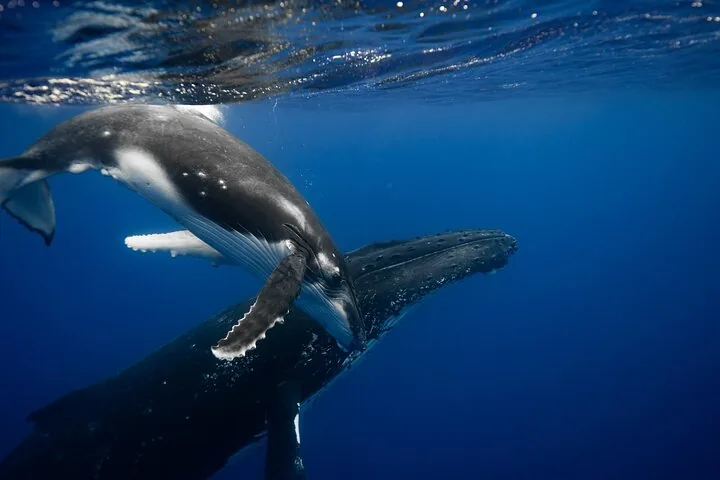
Moorea Whale Watching and Swimming (Lagoon Vibes)
- 4.8/5 (140+ reviews)
- 4 hours
- Free cancellation
- Operated by Lagoon Vibes
Includes Four-hour boat trip beyond the reef with a captain and aquatic guide · Briefing on the rules before swimming · Guided …
You'll choose your date and complete the booking on Viator. Free cancellation up to 24 hours before departure.
Swimming with whales in Moorea at a glance
| Question | Answer |
|---|---|
| Is it allowed? | Yes, on a licensed tour |
| Season | July 20 to November 20 |
| Best months to plan around | August, September and October |
| Length | About 4 hours; one trip runs 3 |
| Price, shared boat | $180 to $393 per person on this site |
| Price, private boat | From $1,269 per group of up to six |
| Swimming ability | Comfortable in open water with mask, snorkel and fins |
| Minimum age to swim | Set by each operator: 12 on some boats, over 15 on others |
| Where you swim | Open ocean, outside the reef |
| Guaranteed? | No, not a sighting and not a swim |
| Gear | Mask, snorkel, fins, plus a life jacket or wetsuit |
Other Experiences
Other experiences you might enjoy
More Moorea whale and lagoon tours, each with its own page and booking link.
Can you swim with whales in Moorea?
Yes. French Polynesia is one of the few places where swimming with humpback whales is legal, and Moorea is one of nine islands where operators can be licensed for it. The whole country’s waters have been a marine mammal sanctuary since May 13, 2002. The sanctuary bans harming, harassing and hunting whales, but it does not ban swimming with them on a licensed tour.
You cannot do it on your own. Private boats, yachts, kayaks and paddleboards must stay 300 meters from a whale, and only a trained, certified guide from a licensed operator may put people in the water. The Moorea Expedition whale swim, Moorea Sea Experience and the other boats on our swim with whales in Moorea page all work under these licenses.
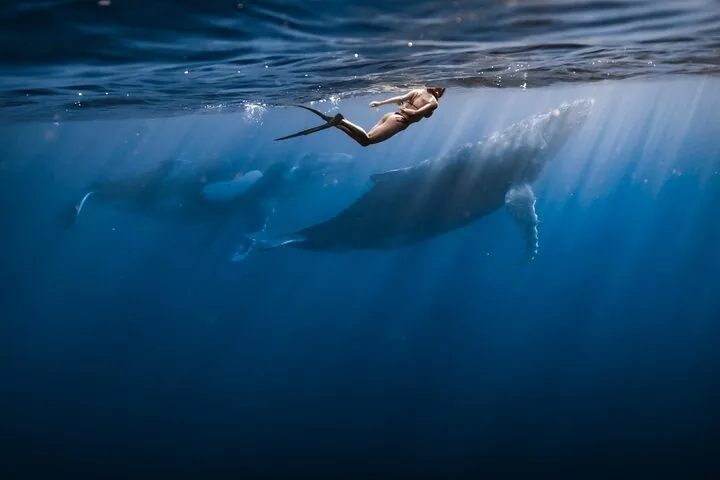
It is not swimming with whales in the sense of following them, touching them or trying to get their attention. You get in some distance from the whale, stay with the guide and float at the surface, and the whale decides what happens next. Sometimes it passes below the group. Sometimes it hangs motionless deeper down, then rises to breathe. Sometimes it swims away. And some days the captain decides the conditions are wrong and everyone stays on board. All of those are what a well-run trip looks like.
For the whales these waters are a nursery: they come from their Antarctic feeding grounds to mate, give birth and raise their calves. That is why the rules below are strict.
How a whale swim works, step by step
- Check in and briefing. You meet the boat, fit your mask and fins, and hear the plan. Good guides explain how to enter the water quietly and how to behave near a whale before you leave the dock.
- The search. The boat leaves the lagoon through a pass and heads into open ocean, where whale watching is allowed. Whales often stay close to shore, so the search may take minutes or most of the morning.
- Watching from the boat. Once a whale is found, the boat stays at least 100 meters away while the guide reads its behavior. The guide is looking for whales calm enough to share the water. If they speed up, dive for longer or move away as the boat approaches, the rules treat that as disturbance and the swim is off.
- Getting in. If the guide says yes, you slide in quietly from the side or back of the boat. You may then have to swim some distance to get into position. The Native Mozcean listing tells guests to expect about 100 meters.
- In the water. You stay at the surface, keep together behind the guide, and let the whale set the distance. You do not chase, dive down or cut across its path. If the whale moves off, the swim is over.
- Back on board. You climb a ladder, or on some boats a rear sled, and the boat either waits for another chance or looks for another whale.
Most trips last about four hours, and the time in the water is often short: a few minutes per entry, sometimes several entries, sometimes none. Some operators end the trip early once a good swim has happened.
How close do the whales come?
That is the question photos rarely answer honestly. The boat keeps its distance and you may not chase, but a whale can choose to travel toward a group in the water, and sometimes one does. You might see a whale clearly from a few tens of meters, or see only a shape fading into the blue. Clear water also makes a big whale look closer than it is. An operator that promises a set distance or a particular photo is promising something it cannot control.
The rules since December 2024
French Polynesia updated its whale rules on December 1, 2024. These are the ones that shape your swim:
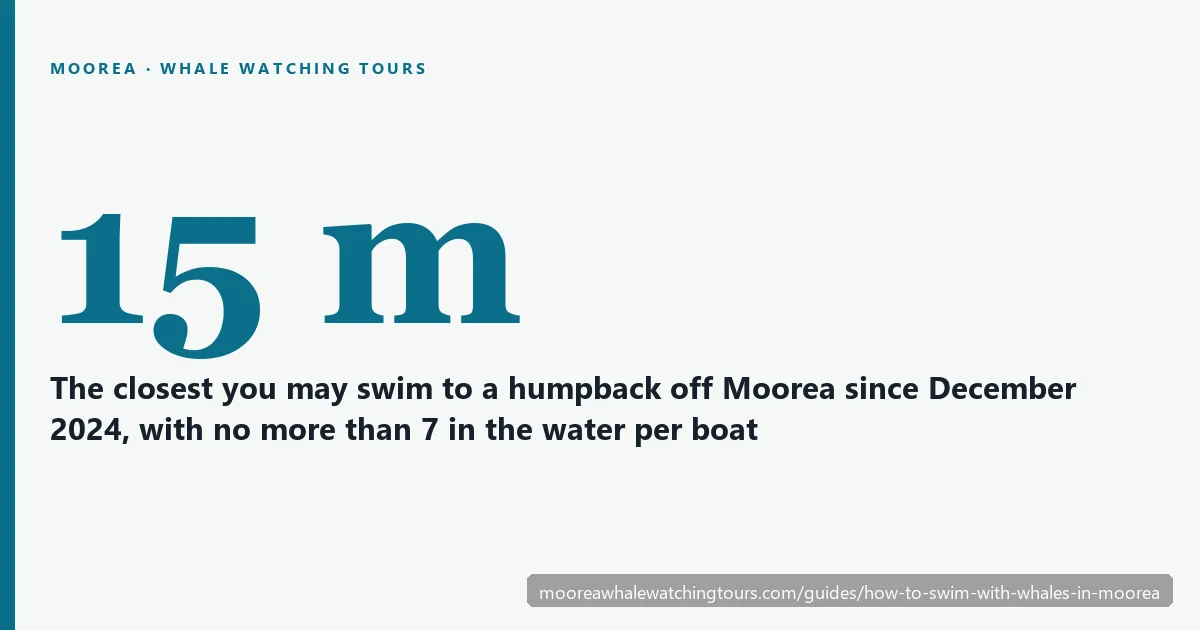
- Swimmers must stay at least 15 meters from a whale. The old limit was 30 meters.
- Licensed boats must stay at least 100 meters away, and private boats 300 meters.
- No more than three licensed boats may be within 300 meters of a whale at once.
- No more than seven people from one boat may be in the water, guide included. That is why listings say six swimmers.
- Watching and swimming are allowed only in the open ocean, never inside lagoons, bays or passes, even when a whale swims into one.
- Tours may only run from July 20 to November 20, between 7:30 a.m. and 5:30 p.m.
- Nobody may come between a mother and her calf, approach a whale head-on or from behind, or do anything that changes its behavior, such as making it speed up, dive longer or split from its group.
The government’s brochure also advises keeping each encounter to about 15 minutes, or less when a newborn calf is present. Gendarmes patrol the season by boat and drone, and an operator caught breaking the rules can lose its license.
One point causes confusion. When a listing says you will swim about 100 meters to the whales, it means the distance you swim from the boat. It has nothing to do with the 100-meter rule for boats.
What the rules mean on the day
- Don’t expect the captain to park beside a whale. The boat stops at the legal distance and the guide decides whether to go in.
- You may have a real swim to reach a spot where you can watch, and the guide tells you when to stop, where to look and when to head back.
- You can’t dive down for a better photo, follow a whale that leaves, or break away from the group. Moorea Moana Tours, for one, tells its guests that freediving is not allowed during encounters.
- Be wary of any operator that promises close contact, a photo beside a calf or a chance to touch a whale. Those promises are not signs of a better trip.
When to go
Any date between July 20 and November 20 can work. If you are planning a whole trip around a swim, September is a sound choice, with August and October close behind.
| Month | What to expect | Our view |
|---|---|---|
| July (from the 20th) | The first whales arriving | Possible, less predictable |
| August | More whales arriving | Very good |
| September | Well inside the season | Excellent |
| October | Whales still here; later in the month matters more | Very good |
| November (to the 20th) | Some whales stay; encounters less predictable | Book early in the month |
| December to June | Outside the season | Book a lagoon snorkel instead |
This is a planning guide, not a sighting rate. Weather, sea state and the whales’ movements change from week to week. The best time to see whales guide goes month by month.
Morning departures are popular because the wind is often lighter early, which makes a calm swim more likely. That is a tendency and doesn’t mean more whales, and water entries can’t start before 7:30 a.m. under the rules. Take a morning slot if you get seasick or want the afternoon free; take an afternoon slot if it suits your plans and the forecast looks good. Our page on morning or afternoon whale watching in Moorea goes into the choice.
What a whale swim costs
On this site, shared whale tours with a swim option run from $180 with Native Mozcean to $393 with Moorea Moana Tours, and the watch-only boat is $144. Private boats start at $1,269 for up to six. Our cost guide sets every tour side by side.
Paying more does not buy a better encounter. Two boats out on the same morning can have completely different days. Check what the price includes before you compare it:
- Whether the tour includes a possible swim or only watching from the boat.
- The number of paying guests on board, not just how many can be in the water.
- Whether a wetsuit, fins and a life jacket are provided.
- Whether hotel pickup and drop-off are included.
- What happens if the operator cancels for weather.
- Whether there is a refund, a second try or nothing if no whales are found.
Which kind of swim tour to book
A small-group swim boat, for most confident swimmers
If seeing a humpback underwater is the reason you came, book a boat that focuses on it, with few guests and time to search without rushing. Moorea Sea Experience and Mori Ora both cap the boat at six. The trade-off is that a whale-only trip spends its time outside the reef and skips the easy lagoon stops.
A whale swim with hotel pickup, booked on GetYourGuide
If you would rather book through GetYourGuide, the Moorea Expedition whale swim is the same trip as the Viator listing ($284 against $289, 4.6 from 150+ reviews) and lists hotel pickup and drop-off.
A private boat, for groups and photographers
A private charter gives your party the boat and lets you set the pace within the rules. The Aimeho private boat is $1,269 for up to six, and Moorea Sea Experience’s private half day is $1,386. A private booking does not change the swimmer cap, the distances, the whales’ behavior or the captain’s safety calls. See private whale watching in Moorea.
Is it safe to swim with whales in Moorea?
For a confident swimmer on a licensed tour, yes. The whales are rarely the main risk. The ocean is: swell, current, wind and the effort of swimming in deep water with nothing to hold on to. One four-star review of a Moorea tour describes swimming close to 100 yards through wind and large swells to reach two whales, and warns that weak swimmers can hold up the whole group.
Operators manage this in a few ways. They require a life jacket for swimmers unless you wear a wetsuit, which also helps you float. The Lagoon Vibes trip leaves the wetsuit out of its price, so ask the crew what they lend, and the Moorea Moana Tours swim includes wetsuits in sizes XS to 4XL. The guide stays with the group and calls everyone back if conditions change.
Is it dangerous to swim with humpback whales?
A humpback can reach about 18 meters and 40 tonnes, so a careless swimmer near a tail or pectoral fin could be hurt. That is the point of the 15-meter rule and of the guide’s control of the group. Humpbacks here are not hunting. They feed on krill in Antarctic waters and do not feed at all while in French Polynesia. Accidents are avoided by keeping your distance and staying calm at the surface.
Seasickness
The slow, rolling search outside the reef is where most people feel it. If you are prone to it, take your usual tablet before you board, on a pharmacist’s advice.
Sharks and other animals
Several shark species live in Moorea’s waters, including outside the reef. A whale swim is not a shark encounter, but open-ocean animals can turn up. Moorea Moana Tours, for example, warns guests that sharks may be seen offshore and briefs them on what to do. A guide may end a swim if any animal causes concern.
Weather
A calm lagoon does not mean a calm ocean. Wind, swell or poor visibility can cancel the trip or rule out getting in. If you have several days on Moorea, book the whale swim early in your stay so there is room to rebook.
Can you swim with a mother and calf?
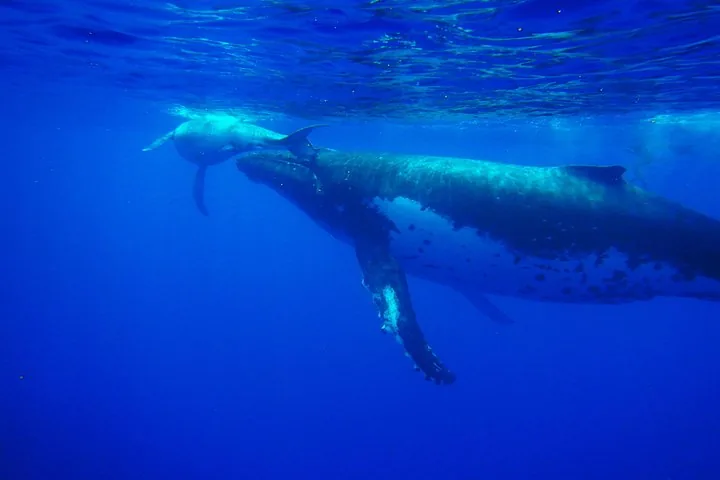
A mother with her calf is one of the most moving things you can see here, and the one that needs the most care. Young calves surface often to breathe, and mothers may rest or travel slowly with them. The rules forbid anyone to come between a mother and her calf. Whether you can watch a pair from the water is the guide’s decision on the day, and a resting pair is not an invitation to get closer. Some operators keep farther back than the law asks: Moorea Moana Tours says its boat stays 150 meters from a mother and calf, against 100 meters for other whales.
Will you hear the whales sing?
Sometimes. Male humpbacks sing long, complex songs in the breeding season, and the low notes carry a long way through water. In the water you may hear deep moans, pulses and higher calls without seeing the singer, and hearing one does not mean it is below you. Not every trip hears song, and some boats carry a hydrophone so you can listen from the deck.
Can you take underwater photos?
Yes, but it is harder than the photos online suggest. You are floating at the surface, moving with the waves, and the whale goes where it wants. A few tips:
- Use a wide-angle or action camera.
- Keep it on a wrist strap that won’t tangle.
- Shoot short video clips when the water is clear.
- Set the camera up before you get in.
- Never dive toward the whale for an angle.
- Keep your eyes on the guide and the group.
If photos are the priority, a private boat gives you more say over the day, but nobody can promise a particular shot.
Is swimming with whales in Moorea ethical?
It can be, if it is done by the rules. The humpbacks that winter in French Polynesia belong to the Oceania subpopulation, which the IUCN lists as Endangered even though humpbacks as a species are not. They come here to mate, give birth and nurse, which makes disturbance a real concern.
The 2024 rules were written with that in mind: fewer boats per whale, more distance for boats, a hard cap on swimmers and a ban on anything that changes a whale’s behavior. You can add to that by how you book and behave:
- Choose a small group. Boats capped at six guests, such as Moorea Sea Experience or Mori Ora, put everyone in the water at once and spend less time around each whale.
- Accept a no. A guide who keeps you on the boat because a mother is restless is doing the job well.
- Never touch, chase or dive toward a whale.
How fit do you need to be?
Fitter than for a lagoon snorkel. The listings are specific. Lagoon Vibes asks swimmers to be over 15, at ease in mask, snorkel and fins, able to fin 300 meters on their own, and able to climb the boat ladder (our breakdown). Moorea Activities Center sets 12 as the minimum age for water entries. Almost every listing advises against the trip for pregnant travelers and people with heart or spinal problems.
Before you book, ask yourself:
- Can I swim a few hundred meters without stopping to stand up?
- Can I breathe calmly through a snorkel in deep water?
- Am I fine when a wave washes over my mask?
- Can I follow instructions in fins while staying with a group?
- Can I climb a boat ladder from the water?
- Am I comfortable in water where I can’t see the bottom?
If several answers are no, practice in the lagoon first or book a boat-only trip.
Can non-swimmers come?
Yes, on several boats. On the Lagoon Vibes trip non-swimmers watch from the boat while others swim, and Moorea Expedition runs a separate watch-only trip from $144. If you are unsure about the swim, an observer place is a better morning than paying for an encounter you don’t want to attempt.
Can children swim with the whales?
Only above each operator’s minimum age, and being allowed on the boat is not the same as being allowed in the water. Moorea Activities Center takes children on board from 5 and in the water from 12; Lagoon Vibes swimmers must be over 15. Check the child’s swimming, how they cope with swell, and whether gear comes in their size. For younger children, a boat-only trip or a lagoon snorkeling tour is the better start, and our family whale watching guide lists the age limits by boat.
If you are still unsure, book a boat with an observer option. You can decide on the day whether to get in, and watching a whale surface beside the boat is a fine morning in its own right. The best whale watching tour guide lists which boats sell observer places.
What to bring
- Swimsuit, towel and a dry layer for the ride back.
- Your own mask and snorkel if you have them. Snorkel gear is included on nearly every trip, but your own mask will usually fit better.
- A wetsuit or rash vest. Some boats include wetsuits; others, like Lagoon Vibes, do not, so check the listing.
- Mineral sunscreen, a hat and sunglasses.
- Motion-sickness tablets, taken before you board.
- A waterproof camera or phone case. Keep it on a wrist strap.
- Your own fins if you have a pair that fits well.
- Drinking water, even if the trip serves drinks.
Do you need a wetsuit?
Not everyone does, but floating at the surface for a long time and getting in several times can leave you chilly. The government’s 2026 brief for Moorea puts the water at 21 to 27°C (about 70 to 81°F) in the southern winter. Ask whether the operator supplies a wetsuit, and which flotation it requires: not every rash vest or thin suit counts.
How to pick a responsible operator
This matters more than the price. The whales here are breeding and raising calves, and a good operator puts them first even when it disappoints the people on board. Check seven things:
- License. Can the operator confirm its authorization for whale swims?
- Group size. How many guests are on board, and how many can be in the water together?
- The guide. Is an experienced guide in the water with the swimmers?
- The whales. Will the crew call off an approach if a whale seems disturbed or moves away?
- Safety gear. Are life jackets or wetsuits available in the right sizes?
- Honest expectations. Does the listing say plainly that sightings and swims are not guaranteed?
- Cancellation. Do you get a refund or a new date if the trip can’t run?
Tahiti Tourisme recommends licensed operators and reminds swimmers never to come between a mother and calf or to box a whale in against the reef. A company that explains why it sometimes keeps everyone on board is a good sign.
A day trip from Tahiti
It can be done if the ferry and the tour times line up. Ferries from Papeete to Vaiare take about 25 to 45 minutes (see our ferry times from Papeete), but Moorea’s whale boats leave from different points around the island, and most are not walking distance from the ferry. A day might run like this:
| Time | Plan |
|---|---|
| Early morning | Ferry from Papeete to Moorea |
| Morning | Transfer to the tour’s meeting point |
| Late morning or afternoon | Whale tour |
| Late afternoon | Back to the Vaiare ferry terminal |
| Evening | Ferry to Tahiti |
Book the tour first, then check the ferry times and how you’ll get to the meeting point. If the tour offers pickup, confirm exactly where and when. If the swim is a main reason for your trip, two or three nights on Moorea give you room when the weather intervenes. Tahiti also has its own boats: see whale watching in Tahiti.
What if you don’t see any whales?
Ask this before you pay. You are paying for the boat, the crew, the gear and the search, not for a sighting. A trip can end in any of these ways:
- You find whales and get in the water.
- You see whales from the boat but a swim isn’t right.
- You see other sea life but no whales.
- The weather shortens or cancels the trip.
Policies differ, and no sighting does not mean a refund unless the terms say so. Avoid booking the swim on your last morning.
Swimming or watching?
| Whale swim | Watching from the boat | |
|---|---|---|
| Swimming needed | Yes | No |
| Open-water confidence | Important | Not needed |
| Effort | Moderate to hard | Low |
| Underwater view | Possible | No |
| Photos | Underwater possible | Easier from the deck |
| Young children | Often restricted | Usually fine |
| Price | Often higher | Often lower |
| Sighting guaranteed | No | No |
Choose the swim if you are already at home snorkeling in deep water and an underwater encounter is the heart of your trip. Choose the boat if you want an easier morning, are traveling with young children, or mainly want to see whales breathe, breach and lift their tails. A humpback throwing itself out of the sea is every bit as memorable as one seen underwater.
Is it worth it?
For confident swimmers who love wildlife, a whale swim can be the most memorable morning of a trip to French Polynesia. From the deck a humpback is a back and a tail in the waves. Underwater you see the whole animal: the long white fins and how easily something that big moves.
It is not for everyone. If deep water makes you uneasy, you get badly seasick, or you need a guaranteed close encounter, book a boat-only trip or a lagoon tour instead. Arrive prepared, pick a responsible operator, and accept that the whales, not the timetable, decide how it goes.
Frequently asked questions
Can you swim with whales in Moorea?
Yes, on a licensed tour between July 20 and November 20. A certified guide takes up to six guests into the open ocean near the whales when conditions and whale behavior allow. You cannot swim with whales from a private boat or kayak.
How do you swim with whales in Moorea?
Book a licensed whale tour, go out in the open ocean with the crew, and wait while the guide watches the whales from at least 100 meters. If the guide says yes, you slip into the water, swim into position and float at the surface at least 15 meters from the whale.
Is it safe to swim with whales in Moorea?
Yes for confident swimmers on a licensed tour. The main risks come from the open ocean, such as swell, current and fatigue. Operators require a life jacket or wetsuit, and the guide stays with the group in the water.
Is it dangerous to swim with humpback whales?
The risk is low when the 15-meter distance is kept. Humpbacks do not feed in French Polynesia, but they are very large, so the danger comes from getting too close to a tail or fin. Follow the guide and never approach a whale.
Is swimming with whales in Moorea ethical?
It can be. The whales here are from an endangered subpopulation, and French Polynesia’s rules limit boats, distances and the number of swimmers. Choose a small-group operator, accept the guide’s call when a swim is off, and never touch or chase a whale.
What is the best month to swim with whales in Moorea?
September is a sound choice, with August and October close behind. Any date from July 20 to November 20 can work, and no month guarantees a swim.
Do you need to be a good swimmer?
Yes. You should be comfortable swimming and snorkeling in open water, and some trips ask you to swim a long way from the boat. A life jacket or wetsuit helps you float but does not make up for weak swimming.
Can beginners swim with whales in Moorea?
Talk to the operator about your experience first. If you are new to snorkeling, practice in the lagoon or book a boat-only trip.
Can children swim with humpback whales?
Only above the operator’s minimum age, which is 12 on some boats and over 15 on others. Younger children can often ride along and watch from the deck.
Can you touch a whale in Moorea?
No. Don’t touch, chase or block a whale. Stay at least 15 meters away and follow the guide.
Is it snorkeling or scuba?
Snorkeling. You float at the surface with mask, snorkel and fins. Scuba is not used, and operators such as Moorea Moana Tours do not allow freediving during encounters.
Are there sharks where you swim with whales?
Sharks live in French Polynesia’s waters, including outside Moorea’s reef, so a sighting is possible. Your guide should brief you on what to do.
Can you swim with whales in December?
No. The legal season ends on November 20. In December, book a lagoon snorkel or reef trip instead.
Is a whale swim better in Moorea or Bora Bora?
Both islands get humpbacks in season. The practical choice depends on where you are staying and which licensed boats are running. Moorea is the easier one if you are already on Tahiti.
Can you swim with whale sharks in Moorea?
No whale shark tours run in Moorea. The whale swims here are with humpback whales. The other animals Moorea boats list are dolphins, pilot whales, turtles, rays and reef sharks.
Ready to pick a boat? Compare them in which Moorea whale tour is right for you, check the best time to see whales, or read our Lagoon Vibes breakdown.
Look for Humpbacks With Six Guests on Board
Free cancellation up to 24 hours before. Moorea Whale Watching and Swimming (Lagoon Vibes) from $231 per person.
Check Availability & Book