Best Time to See Whales in Moorea: Season, Months & Time of Day
If seeing humpback whales is the main reason for your trip, plan for August to October, the middle of Moorea’s whale-watching season. Licensed tours run only from July 20 to November 20, and on the day the wind and sea matter most, because they can stop a trip or a swim.
This guide compares the months, explains how the season works and which trip time to book, and the date checker below shows whether whale tours run on your date and, from about two weeks ahead, the forecast wind and waves.
Licensed whale-watching and whale-swim tours from Moorea are available only from July 20 to November 20, the whale season authorized by French Polynesia’s environment department, between 7:30 a.m. and 5:30 p.m. From December to June the boats offer lagoon and dolphin trips instead. Within the season, timing matters because the humpbacks arrive gradually from July.
If your dates are flexible, plan for August to October, the best overall period for a first whale trip: it is well after the first whales arrive and before the wet season begins. August tends to be drier, and October has noticeably more rainy days. If you can choose only one month, September is the middle of the season.
Late July and November still work. In late July the first whales are still arriving; in November tours stop after the 20th and rain is more frequent. July and September brought the most visitors to French Polynesia in 2025, while August and October were a little quieter, so book small boats ahead.
Once your dates are fixed, there is no single best time of day for seeing whales: choose the morning or afternoon trip that suits your day. Depending on the wind and sea, a trip can be cancelled or a swim called off on any date. Book your whale trip early in your stay and check the wind and wave forecast the day before.
- Best overall for humpbacks:
- August to October
- If you can pick one month:
- September
- Fewer rainy days:
- August (late July is similar)
- Start of the season, whales still arriving:
- Late July (from July 20)
- End of the season, more rain:
- November 1 to 20
- Most visitors to French Polynesia (2025):
- July and September
- No whale tours; lagoon and dolphin trips run:
- November 21 to July 19
- Time of day:
- No single best time
- Most useful exact-date checks:
- Wind · waves · rain
- July 20 to November 20: the authorized season for whale tours in French Polynesia, 7:30 a.m. to 5:30 p.m.
- About 9 and 13 days: with rain in an average August and October at Paopao, on Cook's Bay
- About 26 to 27°C (79 to 81°F): sea temperature around the Society Islands from August to November: fine for a short swim, cool on a long float
Check Availability
The highest-rated Moorea whale trip on this site with more than 100 reviews takes six guests at most and leaves from the public landing on Cook’s Bay. Pick a date to see its departures.
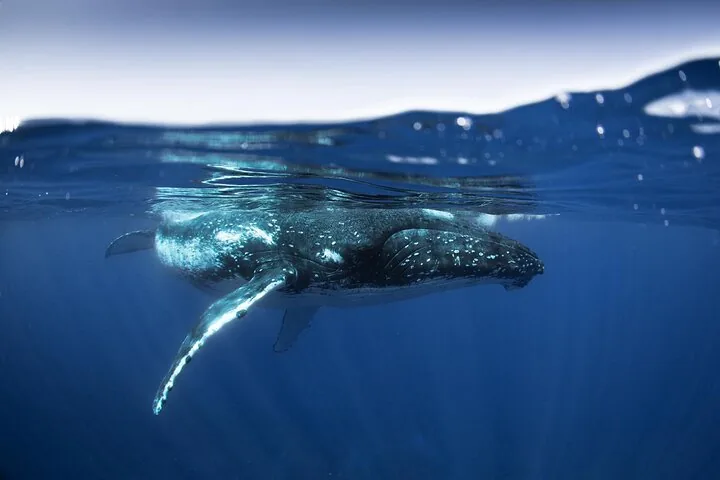
Moorea Half-Day Small-Group Whale Watching (6 Guests)
- 5.0/5 (120+ reviews)
- 4 hours
- Free cancellation
- Operated by Moorea Sea Experience
Includes Half-day boat trip on the open ocean with a guide and captain · Use of snorkeling equipment · Snacks
You'll choose your date and complete the booking on Viator. Free cancellation up to 24 hours before departure.
What a whale trip from Moorea involves
A whale trip from Moorea is a half-day boat trip, usually about three to four hours, on a small boat with a captain and a guide. Boats leave from landings around the island, including Cook’s Bay on the north coast, and head out through a pass in the reef, because whale watching and swimming are allowed only in the open ocean, never in the lagoon, the bays or the passes. The guide looks for blows and splashes, and the boat keeps at least 100 meters from the whale.
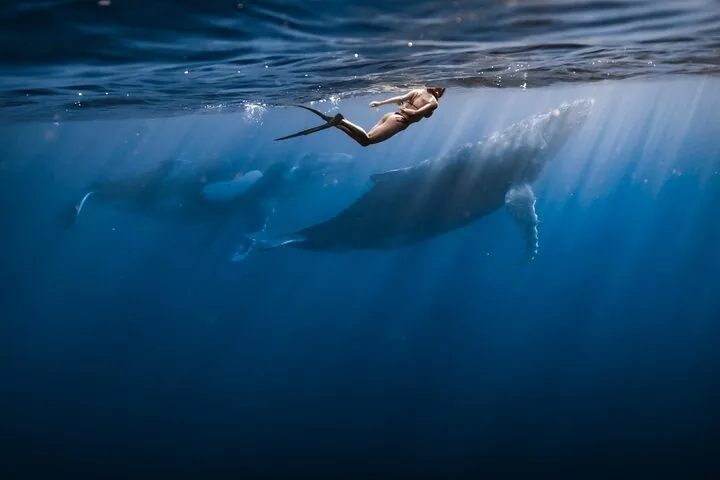
On a swim trip, the guide takes small groups into the water when the whales and the sea allow it. The rules allow seven people in the water per boat, guide included, and swimmers stay at least 15 meters from a whale. Many guests stay on board and watch, which needs no swimming at all.
The whole trip is outside the reef, so the sea matters more than it would on a lagoon trip. On a windy day the open ocean can be choppy even when the lagoon looks calm, and a long float at the surface can leave you cold. Bring sun protection, a layer for the ride back and, if you are prone to seasickness, a tablet taken before you board.
No trip can promise a whale. A sighting may be a distant blow and a curved back as well as a breach close to the boat.
Other Experiences
Other experiences you might enjoy
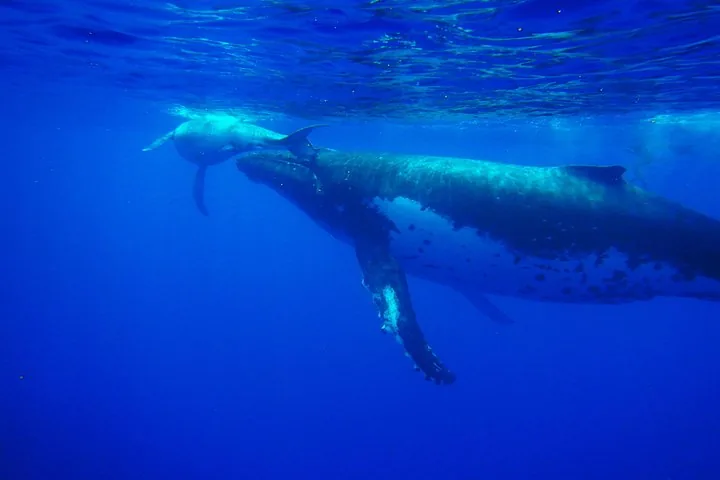
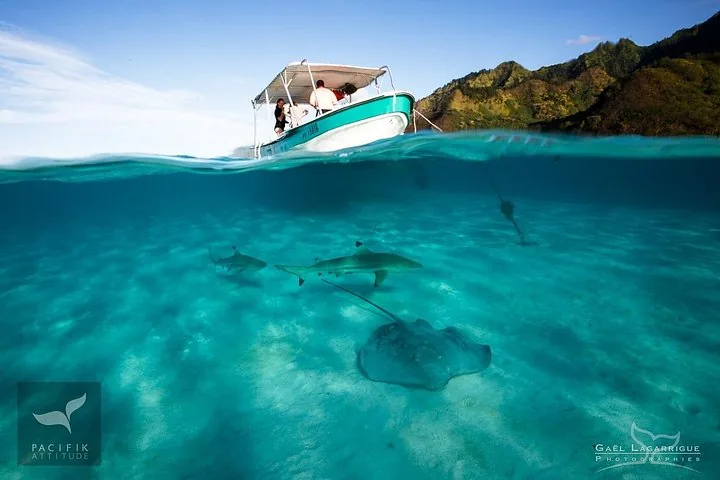
Whale trips, swims, private boats and lagoon snorkeling around Moorea, each with its own page.
Check your date
Pick your date to see whether licensed whale tours run that day and how wet the month usually is. From about two weeks ahead the checker adds the forecast for Moorea’s north coast: waves just outside the reef, the strongest gusts and rain between 7 a.m. and 5 p.m.
Pick your date to see whether licensed whale tours run that day, what the season usually looks like then and, from about two weeks ahead, the forecast wind, waves and rain off Moorea.
Licensed whale-watching and whale-swim tours run from July 20 to November 20, between 7:30 a.m. and 5:30 p.m. Outside those dates, boats run lagoon, snorkeling and dolphin trips.
Season: French Polynesia's environment department (DIREN). Usual weather: Meteo-France averages for Paopao, Moorea. Forecast: Open-Meteo, from about two weeks ahead.
Check whale trip datesCheck lagoon and dolphin trips or see the booking options
How Moorea’s whale season works
Humpback whales swim north from their feeding grounds near Antarctica each southern winter to mate, give birth and nurse their calves in French Polynesia’s warm water. They do not feed here, and they live on their reserves until they head south again. The government’s brochure says they arrive from July to the end of October, and Tahiti Tourisme gives July to November as the months they spend around the islands.
The dates that matter for booking are set by law. French Polynesia is a marine mammal sanctuary, and since December 2024 licensed operators may take guests to watch or swim with whales only from July 20 to November 20 inclusive, between 7:30 a.m. and 5:30 p.m. No more than three licensed boats may be within 300 meters of a whale at once. Private boats, kayaks and paddleboards must keep 300 meters away all year, so a tour is the only way to get close.
The legal season and the whales do not line up exactly. Some whales arrive before July 20, with sightings off Moorea reported in May 2025, and a few stay into December. Researchers describe humpbacks as commonly seen in French Polynesia from July to December. Numbers also change from year to year, so no month comes with a guarantee.
Whale watching in Moorea month by month
Whether whale tours run, the average high and low at Paopao on Cook's Bay, days with rain, the sea temperature, sunset on the 15th, and how many visitors arrived in French Polynesia in 2025.
Jan
31° / 23°C
Busy
Hot and wet, with the fewest visitors of the year. Lagoon and dolphin trips only.
Feb
31° / 23°C
Busy
Still the wet season. Warm water for snorkeling; no whale tours.
Mar
32° / 23°C
Busy
The warmest water of the year. Showers ease a little toward April.
Apr
31° / 23°C
Busy
Showers become less frequent. Lagoon, snorkeling and dolphin trips run.
May
30° / 22°C
Busy
The drier season begins. An early humpback is sometimes reported, but tours may not approach it.
Jun
29° / 21°C
Busy
Drier and a little cooler. A few whales can arrive before the season opens.
Jul
29° / 21°C
Busy
The season opens on July 20, with the first whales still arriving. The busiest month for visitors.
Aug
29° / 20°C
Busy
Well into the season. With July, the fewest rainy days of the year, and the coolest water.
Sep
29° / 21°C
Busy
The middle of the season, with a few more showers than August. The second-busiest month for visitors in 2025.
Oct
30° / 21°C
Busy
Still well inside the season, with noticeably more rainy days than August or September.
Nov
30° / 22°C
Busy
Tours stop after November 20, and the wet season returns. Fewer visitors than July to October.
Dec
31° / 23°C
Busy
The wettest month. A few whales can stay into December, but tours may not approach them.
Temperature: Météo-France's average high and low at Paopao, above Cook's Bay. Out on the water the breeze makes it feel cooler, and early starts from July to September can feel cool.
Busy bar: tourists arriving in French Polynesia in 2025, as a share of July, the busiest month. It counts visitors to the whole territory, not people on a whale boat.
Sources: Whale season: French Polynesia’s environment department (DIREN). Temperature and rain: Météo-France long-term averages for Paopao, Moorea. Sea: NOAA Coral Reef Watch for the Society Islands. Busy bar: visitor arrivals in French Polynesia by month, 2025 (ISPF, the territory’s statistics institute). Sunset: calculated for Moorea on the 15th, 2027. Read November 2026.
Late July is the start of the season. Tours begin on July 20, the first whales are still arriving, and it is the busiest month for visitors to French Polynesia, so book early and leave a spare day for a second trip.
August is well into the season, and with July it has the fewest rainy days of the year. Many local guides describe August and September as the time for singing males, often heard underwater before they are seen, and for groups of males following a female.
September is the middle of the season, with a few more showers than August. Local guides often point to September and October for mothers with young calves resting near the surface, the sight many people hope for. A calf has to breathe often and its mother may rest or swim slowly beside it, which is why the rules forbid anyone to come between them and why a guide may decide not to approach a resting pair.
October is still well inside the season. Rainy days become noticeably more frequent, with about 13 in an average October at Paopao against about 9 in August.
November is the end of the season. Tours stop after November 20, rain is more frequent, and fewer visitors arrive. A November trip can still work if you book it for the first days of your stay.
Weather and sea conditions in whale season
The whale season falls in Moorea’s cooler, drier months. At Paopao, the Météo-France station above Cook’s Bay, average highs stay around 29 to 30°C (84 to 86°F) from July to November, and lows around 20 to 22°C (68 to 72°F), so an early start on the water can feel cool. Days with rain rise through the season, from about 9 in an average July or August to about 13 in October and 14 in November. Most of it falls as showers, and a shower rarely stops a boat.
The sea around the Society Islands averages about 26 to 27°C (79 to 81°F) from August to November, a little cooler in August. That is comfortable for a short swim, but floating at the surface for half an hour can still leave you chilly, and a thin wetsuit helps.
Wind and swell make more difference than rain. The trade winds blow from the east and turn southeast in the cooler months, and the mara’amu, a strong southeast wind, can raise a steep, short sea outside the reef while the lagoon stays calm. On those days a trip can be rough, a swim can be called off, or the operator can cancel. These are day-to-day changes, so the forecast for your own date matters more than the month. Météo-France Polynésie publishes the marine forecast at meteo.pf, and the date checker above shows the forecast wind and waves from about two weeks ahead.
How busy Moorea gets in whale season
The best monthly guide to demand is the number of tourists arriving in French Polynesia, published by ISPF, the territory’s statistics institute. It counts visitors to the whole territory, not people on a whale boat, but it shows the pattern. In 2025 July was the busiest month, with about 31,000 arrivals, followed by September with about 28,000. August and October each had about 25,000, and November about 20,000.
Whale boats are small, and some take six guests at most, so a popular date can fill. Book once your dates are fairly certain, especially for July and September, and choose a listing with clear terms on weather cancellations.
Which time of day to book
Many operators run a morning and an afternoon trip inside the legal hours, 7:30 a.m. to 5:30 p.m. Whales surface and dive all day, and no departure time is known to bring more of them; at least one Moorea operator tells guests plainly that no time slot has better odds. Some operators find the sea often calmer in the morning, before the trade winds build, which helps if you are prone to seasickness, but this is a tendency and not a rule. Check the forecast for your day and pick the slot that suits the rest of it. The morning or afternoon whale watching in Moorea guide compares the two in more detail.
Outside the whale season
From November 21 to July 19, licensed tours may not approach whales. You might still see one from shore or from the ferry, especially in June or December, but treat it as a bonus.
Moorea’s other sea life is there all year. Spinner dolphins rest in the bays and near the passes by day, and the lagoon has turtles, rays and blacktip reef sharks. The Moorea Sea Experience snorkeling and dolphin trip (5.0 from 20+ reviews) runs whatever the month, and our Moorea snorkeling tours page compares the lagoon trips. For the rest of the island’s year, see the best time to visit Moorea.
Which whale trip to book for your dates
For most season dates, the Moorea Sea Experience half-day small-group trip is the easiest choice: it is the highest-rated Moorea whale trip on this site with more than 100 reviews (5.0 from 120+ reviews), takes six guests at most and leaves from the public landing on Cook’s Bay (our breakdown). The Pacifik Attitude whale and marine life tour (4.9 from 200+ reviews) has more reviews and includes transport and food, but it is the second most expensive shared trip on this site per person (our breakdown).
If you would rather have a boat to yourselves, our private whale watching in Moorea page compares the private charters, which are priced per group. For every boat side by side, see which Moorea whale tour is right for you.
How we know
Sources and limits
- Whale season and rules: DIREN, French Polynesia’s environment department, Comment observer les mammifères marins en Polynésie française (2025 edition): approaches authorized from July 20 to November 20 inclusive, 7:30 a.m. to 5:30 p.m., in the territorial sea of nine islands including Moorea; a 300-meter observation zone with at most three authorized boats, 100 meters for boats, 15 meters for people, seven people in the water per boat including the guide; observation banned in lagoons, bays and passes; whales arrive “from July to the end of October”. No 2026 edition was found; operators’ 2026 listings give the same dates. Read November 18, 2026.
- Whale presence: Tahiti Tourisme (July to November); Gannier (2004), Aquatic Mammals 30(2), on humpbacks commonly seen from July to December and survey records from September to November; Tahiti Presse (May 2025) for early sightings off Moorea.
- Timing within the season: the descriptions of singing males and mothers with calves come from local guides and operators and vary between them. We do not have a published monthly count of whales off Moorea, so the page does not name a peak week or say which month has the most whales.
- Weather: Météo-France fiche climatologique for Paopao 1, Moorea (station 98729003, 100 m), rain 1991-2020 and temperature 1997-2020. The station sits in the valley above Cook’s Bay, so it is wetter than Moorea’s drier coasts and says nothing about the sea outside the reef. Faa’a, on Tahiti, records far fewer rainy days (about 4 to 5 a month from July to September) for the same period. Mara’amu and trade winds: Météo-France Polynésie bulletins and the 2026 Moorea boaters’ brief.
- Sea temperature: NOAA Coral Reef Watch, Society Archipelago virtual station, averaged monthly means (satellite, offshore).
- Visitors: ISPF, Fréquentation touristique, monthly bulletins for 2025 (281,227 tourists in the year). A territory-wide proxy for demand, one year only: it does not count people on a whale boat or on Moorea.
- Time of day: operators’ published departure times; Moorea Moana Tours on time slots and sightings.
- Ratings: Viator and GetYourGuide, read November 18, 2026. The forecast in the date checker is Open-Meteo’s; it is a forecast, not a promise, and the operator makes the call on the day.
Frequently asked questions
When is whale season in Moorea?
Licensed whale-watching and whale-swim tours run from July 20 to November 20 each year, between 7:30 a.m. and 5:30 p.m. Humpbacks arrive from July, and a few come earlier or stay into December, but licensed boats may not take you to them outside those dates.
What is the best month to see whales in Moorea?
September, if you can choose only one month: it is the middle of the season, with whales well established and fewer rainy days than October. August and October are just as good choices for a whale trip; August is a little drier and October a little wetter.
When is peak whale season in Moorea?
There is no official peak. August to October is the main part of the season, between the first arrivals in July and the end of tours on November 20. Many local guides describe August and September as the time for singing males and competitive groups, and September and October for mothers with young calves.
When does whale season start in Moorea?
Licensed tours start on July 20. The first humpbacks can arrive weeks earlier, and sightings have been reported off Moorea as early as May, but tours may not approach them before the season opens. If your trip is in late July, leave room for a second whale trip.
Is July a good month for whale watching in Moorea?
Late July can be good, but it is the start of the season, so whales are still arriving. Tours begin on July 20; before that, licensed boats may not take you to them. July was also the busiest month for visitors to French Polynesia in 2025, so book a small boat ahead.
Is November too late to see whales in Moorea?
Not in the first part of the month. Tours run until November 20, and whales can still be around, but rain is more frequent than earlier in the season. Book your trip for the start of your stay so a cancelled trip can be moved before the 20th.
Can you see whales in Moorea in December?
Possibly from shore or from the ferry, as a few humpbacks stay into December, but licensed tours cannot take you to them: the season ends on November 20. In December, book a dolphin watching trip or a lagoon snorkeling trip.
Can you swim with whales in Moorea in May?
No. Whales are occasionally reported in May, but swimming with them is allowed only on licensed tours between July 20 and November 20. Private boats, kayaks and paddleboards must stay at least 300 meters from a whale at all times.
What time of day is best for whale watching in Moorea?
No departure time is known to bring more whales, and operators run both morning and afternoon trips between 7:30 a.m. and 5:30 p.m. Some operators find the sea often calmer in the morning, which helps if you are prone to seasickness, but check the forecast for your day. Our page on morning or afternoon whale watching in Moorea compares the two.
Are whale sightings guaranteed in September?
No. September is in the middle of the season, but no month and no trip can guarantee a sighting or a swim. The whales’ movements and the sea on the day decide what a trip finds, and wind and waves can stop a trip altogether.
To choose a boat, see which Moorea whale tour is right for you; for the rules in the water, see how to swim with whales in Moorea; and for the rest of the island’s year, see the best time to visit Moorea.
Check Moorea Whale Trip Dates
Licensed whale tours run from July 20 to November 20. Book your trip early in your stay, and check the wind and waves the day before.
Check Availability & Book